Banned Colors and Broken Pencils: The Strange Rulebook That Keeps Harada's Work Young
Ask most American creatives about their dream working conditions and you'll hear the same fantasy: total freedom. No briefs, no deadlines, no limits. Just a blank canvas and endless possibility.
Harada Masayuki would tell you that's a recipe for paralysis.
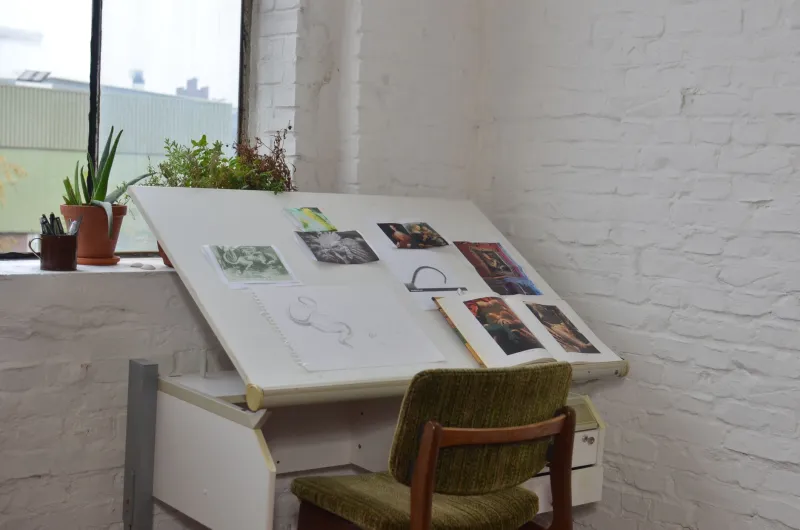
Taped above the drawing table in his Tokyo studio is a single sheet of paper, handwritten and re-taped so many times the corners have gone soft. It's his personal rulebook — a short list of constraints he's imposed on himself, some for decades. And the strangest part? He credits that list with keeping his work alive.
The Color That Shall Not Be Named
Let's start with the rule everyone asks about first: there's one color Harada simply will not use.
He won't say which one in interviews — he'll only smile and say "you'd notice if I told you." Fans have spent years playing detective, comparing palettes across his catalog. The prevailing theory among his English-speaking fanbase, based on a deep-dive thread that made the rounds on Reddit, is a particular shade of saturated violet. Harada has never confirmed it, which is exactly how he likes it.
"The ban isn't really about the color," he explains. "It's about having one door that's always locked. When one door is locked, you stop staring at it and start noticing the ten doors you forgot you had."
He adopted the rule roughly twelve years ago, after catching himself reaching for the same familiar palette on three consecutive projects. The ban forced him back into mixing colors by instinct rather than habit — and the work immediately got stranger, in a good way.
Never Draw From a Photo
The second rule sounds almost masochistic in the age of unlimited reference material: Harada doesn't draw from photographs. Ever.
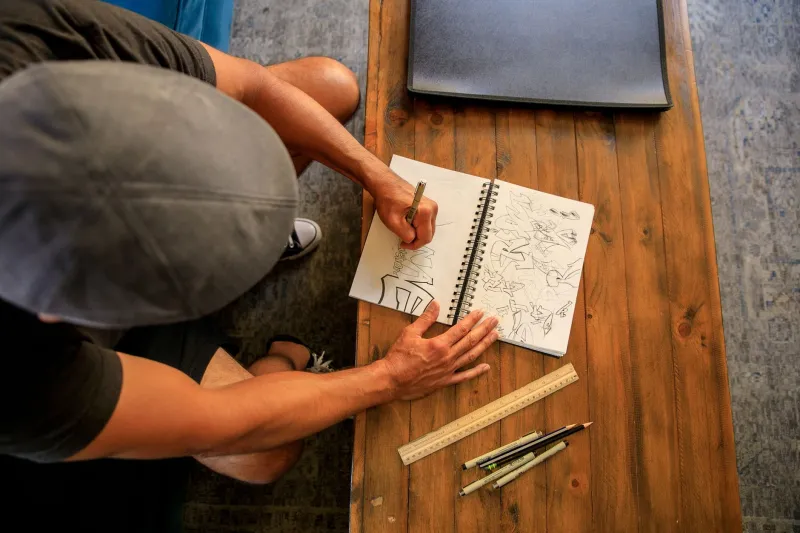
If he needs to draw a train station, he goes to a train station. If it's a specific Tokyo neighborhood, he walks it — often more than once — and draws from memory back at the studio. For American readers, think of it as the difference between looking up a restaurant on Google Street View versus actually eating there. The photo gives you information. The memory gives you a point of view.
"A photograph is someone else's eye," he says. "When I draw from what I remember, I can only keep what moved me. So the drawing is already edited before I pick up the pen."
It also explains something fans have long noticed: his locations feel lived-in rather than documented. The vending machine is always slightly crooked. The crosswalk always has a story.
The Page Ceiling
The third rule flips conventional productivity wisdom on its head. Harada caps his daily output. Once the day's page count is reached, he stops — even if he's mid-scene, even if the momentum is good.
For a culture obsessed with hustle, this might be the hardest rule to swallow. We celebrate the all-nighter. We romanticize the artist who forgets to eat. Harada's take: stopping while you still want to continue is how you guarantee you'll want to continue tomorrow.
"If I always finish the scene, the next morning starts with a blank page," he says. "If I always stop in the middle, the next morning starts with a question. Questions are easier to answer than blanks."
It's the same trick Hemingway famously used — stopping mid-sentence — and it's been quietly keeping Harada's momentum going for years.
Why Restrictions Work
There's actual psychology behind this. Researchers who study creativity have found that constraints often outperform open-ended freedom, because the brain works harder within limits. Jazz musicians thrive on chord changes. Haiku poets thrive on seventeen syllables. Dr. Seuss wrote Green Eggs and Ham on a bet that he couldn't use only fifty words.
Harada's rulebook is the same principle applied to a career. Four decades in, most creators either repeat themselves or chase trends. His constraints do the opposite: they make repetition impossible and trend-chasing irrelevant. The banned color can't come back into fashion because it was never coming back at all. The no-photo rule can't be automated away because it depends on him showing up in the world.
The Rules Are Allowed to Change — Slowly
One last detail worth knowing: the rulebook isn't sacred. Rules get reviewed, occasionally retired, occasionally replaced. But there's a waiting period. A rule has to serve for at least a full year before it can be removed, and a new rule has to survive a full year before it becomes permanent.
"Rules are like tools," Harada says. "You keep the ones that still cut."
The paper above his desk has been rewritten maybe half a dozen times in forty years. That, he insists, is the real secret. Not the rules themselves, but the willingness to be the kind of artist who takes his own discipline seriously enough to question it.
The rest of us can start smaller: pick one thing to ban this week. One color. One shortcut. One habit that's been running on autopilot. Lock that door, and see which others swing open.