Leaving Room to Breathe: The Empty Spaces That Do the Heavy Lifting in Harada Masayuki's Art
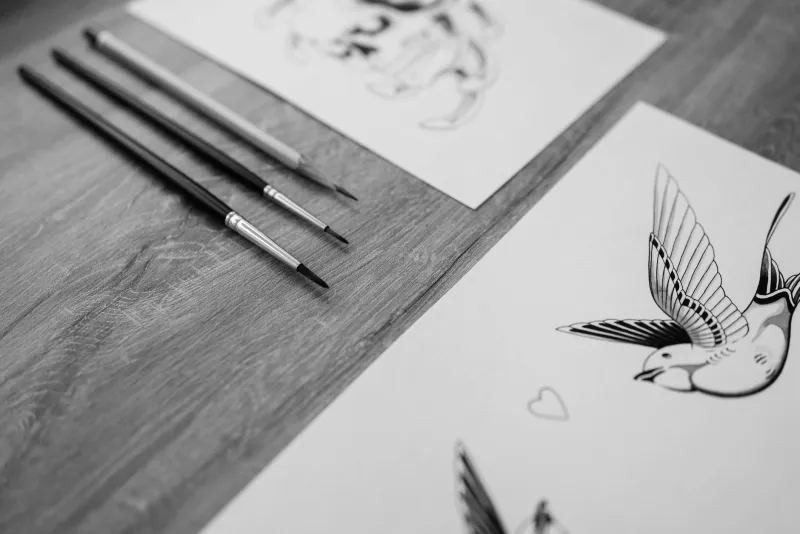
Ask a room full of American cartoonists what makes a page feel powerful, and most of them will point at the ink. The heavy blacks of a Frank Miller panel. The confident line weight of a Charles Schulz strip, which somehow says more with a squiggle than most artists say with a fully rendered face. We're a culture raised on ink — bold, committed, covering the page.
Harada Masayuki works in the opposite direction. Spend any time with his finished pieces and you'll notice something almost unsettling: how much of the paper is just... paper. Not painted over, not textured, not filled with atmospheric wash. Just left alone. And somehow, those empty stretches carry as much emotional weight as anything he actually draws.
The Panel That Started This Obsession
The piece that convinced me to write this is a street scene Harada finished a couple of years back — a lone figure at a crossing, rain implied rather than drawn. What most visitors to the studio never see is the journey that panel took, because Harada keeps his process layers in a filing cabinet like they're tax documents. He pulled them out for us anyway.
The first version is chaos. A fully penciled city block — signage, puddles, a dozen background pedestrians, telephone wires crossing every inch of sky. Honestly? It's great. It's the kind of dense, generous world-building American readers associate with the best indie comics out of Portland or Brooklyn.
The second pass cuts the crowd. The third deletes the wires. By the final version, the figure stands in a field of untouched white with maybe six lines total describing the entire environment. Everything else — the weather, the mood, the loneliness — happens inside your head.
Why Americans Read Silence as Confidence
There's a reason this approach lands so hard with US audiences, and it's not just novelty. American visual culture has its own negative-space tradition — think of Saul Bass movie posters, where a handful of shapes carry an entire film's tension, or the great New Yorker cartoons, where the joke lives in the gap between the drawing and the caption.
But mainstream American comics trained us to equate effort with density. More rendering, more craft. So when a US fan first scrolls through Harada's portfolio and hits a piece that's eighty percent empty, there's a moment of recalibration. Then, usually, a second look. Then a long one.
Harada has a phrase he uses when he talks about this, something about the drawing needing "room to be finished by whoever's looking at it." It sounds modest, but it's actually a power move. He's deciding what you get to imagine. Every blank area is a question he's chosen not to answer for you.
The Deletion Pass
Watching him work, the striking thing is that the emptiness isn't designed — it's earned through subtraction. Harada calls it his "deletion pass," and it happens near the end of every piece, after the composition already works. He goes through and asks one question of every element: if this disappeared, would the picture mean less?
If the answer is no, it goes. Signage goes. Shading goes. Sometimes whole figures vanish between one draft and the next. It's the visual equivalent of a self-edit where you cut your favorite sentence because the paragraph survives without it — the thing every American writing teacher preaches and almost nobody enjoys doing.
What's Missing Is the Message
Here's the part I keep coming back to. When fans email the studio from the States — and they do, constantly — the comments about the sparse pieces are different in kind from everything else. People don't say "beautiful" or "detailed." They say things like "I felt like I was standing there" or "I don't know why, but this one got me."
That's the white space working. The emptiness isn't a void; it's an invitation. American readers, raised on pages that explain everything, suddenly get handed a picture that trusts them — and they respond to that trust before they can even articulate why.
Harada, for his part, shrugs when asked about it. The paper was already there, he says. Using all of it seemed wasteful.
Sure. But look at the final panel — that lone figure, that sea of white — and tell me wasteful is the right word. The man is doing more with nothing than most of us do with everything.