No Tubes Allowed: The Pigment Tin That Hasn't Left Harada's Side Since 1994
Ask Harada Masayuki what color his most famous piece is, and he won't say blue or teal or anything you'd find on a paint store shelf. He'll say something like "the one from the rain in Nakano, 1998" — because to him, every color in the studio has a memory attached.
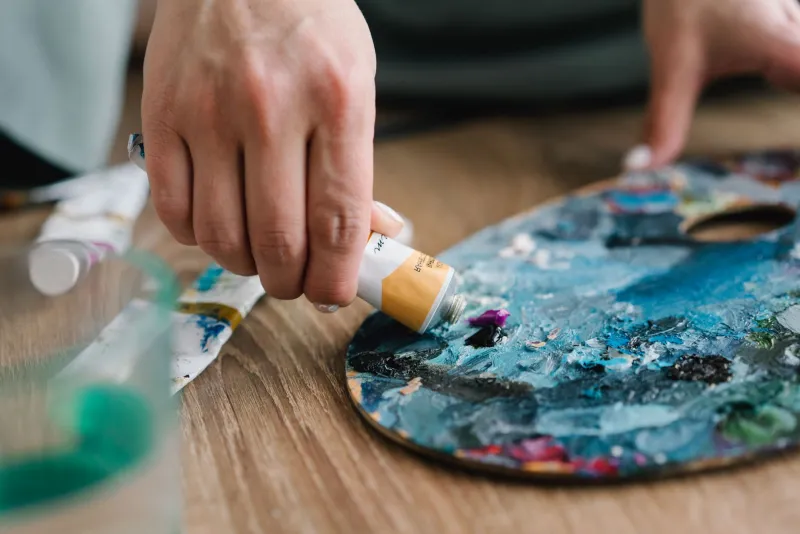
That's the whole point. Harada hasn't purchased a single tube of ready-made paint since the mid-1990s. Everything on his pages starts as raw pigment, mixed by hand, from a pair of dented tins he's hauled between studios for over thirty years.
Why Not Just Buy the Color?
When I asked him the obvious question, he laughed. "If you buy a tube, the company has already decided the color for you. Then a million other people own the same decision."
For Harada, mixing isn't nostalgia — it's authorship. A factory teal is the same teal in Tokyo, Ohio, and Osaka. But the slightly grayed, almost tired blue he mixes from ultramarine, a whisper of raw umber, and a touch of white exists exactly once, in his tin, on his table.
There's a practical side, too. Hand-mixed batches are small, which means colors shift subtly from session to session. Rather than fight that inconsistency, Harada treats it as a feature. "The painting remembers the day it was made," he says. Fans have learned to date his work partly by its palette.
The Tins Themselves
The setup is almost comically modest: two metal tins that once held tea, one for warm pigments, one for cool. Inside, small screw-top jars of dry pigment — earth tones he's had since the nineties, plus a few newer additions. A palette knife worn down to a nub. And a battered notebook where he logs every mix, sometimes just a smudge of the color and a scribbled note like "too cheerful, add gray."
The notebook is the real treasure. It reads like a diary written in color: mixes tied to seasons, moods, even specific train rides. When a piece from years ago needs a touch-up, Harada doesn't guess — he looks it up.
The Colors Americans Keep Getting Wrong
Here's a fun wrinkle: US fans constantly misidentify his signature shades. His most-asked-about color — that dusky, greenish blue that shows up everywhere in his work — gets called "teal," "seafoam," even "vintage turquoise" in American fan discussions.
Harada finds this genuinely delightful. "A color's name changes with the light in the room and the year you were born," he says. The actual mix is closer to what traditional Japanese painters might call a muted ai — a blue pulled toward gray and green by raw umber — but he's stopped correcting anyone. "If it makes someone in Chicago think of their grandmother's kitchen, the color is doing its job."
Try It Yourself: Mixing Harada's Core Palette
Want to experiment at home? You don't need rare pigments. Start with a basic set of acrylics (yes, tubes — Harada forgives beginners) and try these ratios:
The Dusk Blue (his most famous shade):
- 5 parts ultramarine blue
- 2 parts titanium white
- 1 part raw umber
- A small touch of green (start with a quarter part)
The Warm Paper Red:
- 4 parts cadmium red light (or any warm red)
- 3 parts yellow ochre
- 1 part white
The Tokyo Gray-Green:
- 3 parts sap green
- 2 parts neutral gray
- 1 part yellow ochre
- White to soften
Harada's advice for first-timers: mix too much, not too little. "You can never match yesterday's batch exactly, and you shouldn't want to. But running out mid-painting teaches you nothing. Running over teaches you where the color's limits are."
And keep a log. A smudge, a date, a note about the weather. That's the part of the ritual that matters most — the paint is just the evidence.
One Color, One Day
Harada's palette isn't a system you can copy exactly, and that's the point. The tins, the notebook, the refusal to outsource the decision — it all adds up to work that could only come from one person, one place, one moment in time.
"Every color I own, I made," he says, closing the tea tin. "So every painting is mine all the way down."
For a creator whose work has traveled far beyond his small Tokyo studio, that's a kind of home you can carry in two dented tins.