One Day a Year, One Shade of Blue: Inside Harada's Longest Game
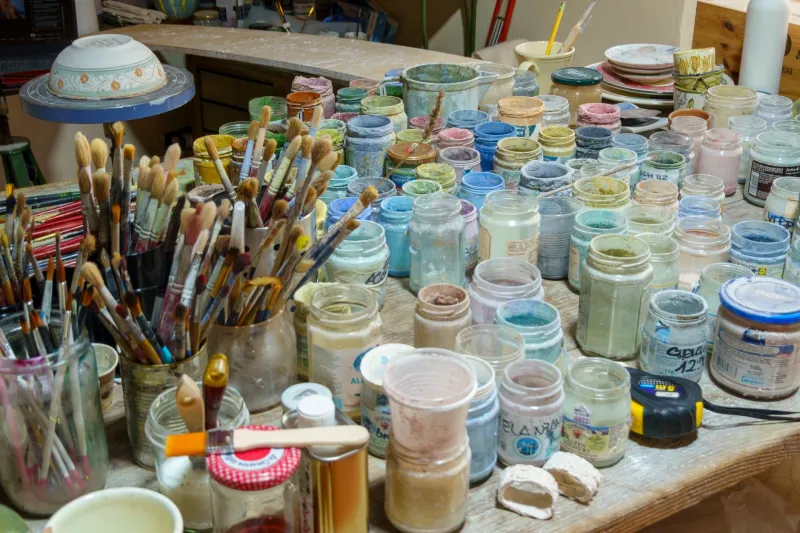
There's a jar in the back of Harada Masayuki's studio that most visitors never notice. It sits on a shelf above the window, half-hidden behind a stack of old art magazines, and it holds exactly one thing: a pigment he calls one-day blue.
He mixes it once a year. He uses it once a year. And then he waits ten years before anyone — including, sometimes, himself — gets a proper look at what he made with it.
The Rules of the Ritual
The routine hasn't changed since the late 1990s. On one fixed date each year — Harada won't say which one, only that it's "a day that stopped being sad and started being useful" — he clears the afternoon, mixes the pigment from scratch, and produces a single painting using that day's shade of blue as the anchor color.
Then the piece goes into a flat file. It stays there for ten years.
"If I sell it, it's a product," he told me, shrugging. "If I show it right away, it becomes an announcement. I don't want either of those things from this one day."
The decade-long embargo is the part that stops most American artists cold. We live in a culture of the immediate drop — post the work-in-progress, tease the reveal, build the email list before the paint dries. Harada's annual painting runs in the opposite direction entirely. It's not content. It's a private appointment with himself that happens to produce an object.
Why Blue, and Why Once
The shade itself shifts slightly every year, because Harada refuses to write down the formula. He works from memory, from feel, from whatever the light in the studio is doing that afternoon. Some years the blue leans toward the gray of Tokyo rain on asphalt. Other years it comes out closer to the electric cyan of a vending machine sign at 2 a.m.
"If I recorded the recipe, it would become a product too," he says. "The forgetting is part of the mixing."
This drives his few studio visitors slightly crazy. One American collector, on a visit last spring, reportedly begged him to just photograph the pigment ratios. Harada's response: he poured a little of the year's blue onto a scrap of cardboard, let it dry, and handed it over. "Here. That's your record."
What a Decade in a Drawer Does to a Painting
Here's where the ritual gets genuinely interesting. When a piece finally comes out of the flat file, Harada sees it with a ten-year gap in his memory. He says the experience is closer to looking at a stranger's work than his own — he can't fully reconstruct his headspace from the day he made it, so he judges the painting the way he'd judge anyone's.
"Some of them I'm embarrassed by," he admits. "Some of them I don't remember making at all. One year I apparently went through a phase where everything was very angry. That one took a full decade to become interesting to me."
The ten-year rule also acts as a filter on his own nostalgia. Whatever looks good after ten years of silence genuinely holds up. Whatever doesn't has still done its job — it marked a day, kept the ritual alive, and taught him something about the artist he was that year.
The Case for the Once-a-Year Project
American creative culture is obsessed with output metrics. Post daily. Ship weekly. Build in public. Against that backdrop, a once-a-annual painting that nobody can see for a decade sounds almost like sabotage.
But spend an afternoon around Harada and the logic clicks. The ritual isn't about the painting. It's about having one corner of the practice that answers to nobody — no client, no audience, no algorithm, no deadline except the calendar itself. It's the one day a year where the work is guaranteed to be uncompromised.
"Everything else I make, somebody is waiting for it," he says. "This one, nobody is waiting. So it's the only thing that's completely mine."
There's a lesson in there for anyone grinding through a creative practice back in the States. You don't need a ten-year embargo to steal the idea. You need one project, on one recurring day, that no one else will ever see on its scheduled date. A sketchbook that never goes on Instagram. A song you record every birthday and don't play for anyone. A jar of paint mixed from a formula you're allowed to forget.
The first of Harada's one-day paintings is now old enough to have been shown, and a handful of the early ones have trickled into exhibitions over the past few years. Fans who've seen them in person describe a strange quality — not better or worse than his commercial work, but calmer. Unhurried. Like something that never once worried about being seen.
Which, of course, for ten years, it wasn't.