Twelve Months, Two Sketchbooks, One Transpacific Conversation
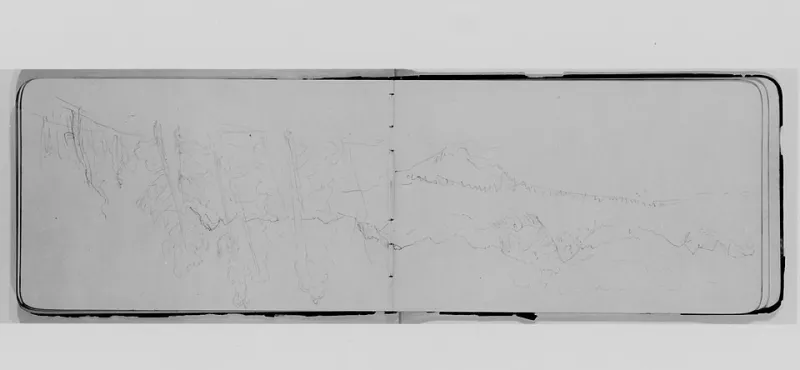
Photo: Albert Bierstadt, CC0, via Wikimedia Commons
There are projects that get planned, and there are projects that happen because someone put something in a mailbox.
The sketchbook swap of 2016 belongs firmly in the second category. It started with a fan letter — one of hundreds Harada receives — from an art student at a small college in Kansas. Unlike most fan mail, this one included a question Harada couldn't shake: What do you do with the drawings that don't work?
Instead of answering, Harada did something better. He mailed her his current sketchbook.
No Instructions, No Rules
The package that arrived in Wichita contained one of Harada's personal notebooks — the kind he fills with half-formed ideas, failed compositions, and the occasional grocery list in the margins. Tucked inside was a single sticky note: "Fill it. Send it back."
That was the whole deal. No theme, no deadline, no explanation of what he wanted. The student, who we'll call M. at her request, had roughly six weeks before it was her turn to mail.
When the notebook came back, Harada found his own pages annotated in pencil — honest, sometimes blunt reactions in the margins. Next to a character study he'd abandoned halfway, she'd written: "You stopped because you got bored, not because it was bad."
"That sentence," Harada says now, "was the best critique I ever received."
The Rhythm of the Exchange
What was supposed to be a one-time gesture turned into a twelve-month relay. Each artist filled the book, annotated the other's pages, and sent it back across the Pacific. Roughly every six weeks, the same battered notebook made the flight between Tokyo and Kansas.
A second sketchbook eventually joined the experiment — M. sent one of hers, and the two books began traveling in opposite directions like slow, heavy letters.
The rhythm shaped the work. Harada admits he started drawing differently once he knew someone else would be reading the pages. Not to impress — he's quick to say that — but to be legible. M., meanwhile, used the exchange to test ideas she was too nervous to show her professors.
What Each of Them Learned
For Harada, the swap surfaced something he'd never gotten from Japanese critics or editors: an outsider's read on his visual instincts. American readers, he noticed, reacted to entirely different parts of a page than his Tokyo peers did. Where a Japanese editor might comment on linework, M. would circle the empty space and ask why it felt lonely.
For M., the lesson was about volume and honesty. Seeing a professional's failures — the crossed-out pages, the dead ends — reframe what a sketchbook is for. It isn't a portfolio. It's a workshop.
By month nine, the annotations had become a conversation in themselves. Some pages are more dialogue than drawing.
Coming to an American Gallery
The quiet punchline: the two sketchbooks are now scheduled for a joint exhibition in the United States, displayed side by side with pages open, annotations visible. Visitors will be able to read the exchange in roughly the order it happened — a year-long conversation between two artists who met exactly once on a video call.
Harada has one request for the curators: don't clean up the margins. The pencil notes stay.
"People think critique comes from experts," he says. "Sometimes it comes from a stranger in Kansas with a pencil and nothing to lose."
We'll share exhibition dates and the city as soon as they're confirmed. Until then, the notebooks are resting — filled, annotated, and finally, for the first time in a year, staying put.